Monday, February 17, 2014

The Art of Leslie Marmon Silko

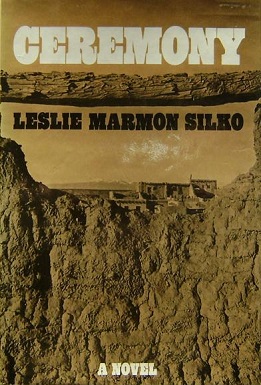
When asked to write a blog post this week on the novel Ceremony  by Leslie Marmon Silko, I am not sure what to write about. Not only have I written several blog posts on this novel already, but so much has happened within the story that it has become much harder too put my thoughts and feelings about this novel into words. Now that my class and I are half-way done with the novel, and the reading has become harder and more confusing with its jumps in time and symbolism I find it hard to write about one thing and only for a few paragraphs. Even so the pure poetic genius of writing writing Silko has create within this story continues to amaze me.
Never have I read a book in which takes such delicate matters such as racism and P.T.S.D. and truly digs into them. Most authors of historical fiction novels are afraid to dig as deeply as Silko has into the truth in these matters, and yet Silko does her digging not only correctly, but in beautiful style, making the writing flow while making the reader think as well. Silko's art is more about pulling at the emotions and at the strings of the human mind then writing a good novel and or that I am grateful. Silko's novel by far has been one the toughest and one of the most wonderful novels I have read within in school and my life. This will be one of the few book that will change my view point on life.

Sunday, February 9, 2014

The Stories That Heal

The novel Ceremony by Leslie Marmon Silko has many messages thorough out it, and depending on who reads the novel, the more underlying messages that are discovered. Some of the obvious messages though include; healing through culture and story telling, the racism between Whites and the native Americans, P.T.S.D, racism between Native Americans, and even some sexism. For me I really feel a connection to the idea of story telling healing and the deeper parts of racism that really comes into the light in this novel.  Below I have put two of my favorite quotes from the novel, that ring with what I feel,  Silko is trying to get to in her story  of Tayo's tale.
1. The first is about story telling. After coming back from the war the main character, Tayo, is starting to see how stories will heal him with time. Before the war he don't totally understand how important stories where not just to his culture, but to himself. While suffering with his P.T.S.D., Tayo beings to see what his grandmother and other people in his culture meant with story telling and slowly without knowing it, it has began to heal him.
2. The second quote in about racism and was said the female character Night Swan, a woman who was both involved with Tayo and his uncle, Josiah. Nigh Swan, being of mixed blood herself, says this to Tayo who has been criticized his whole life for being a half breed and not full Native American, creating not only more racism with Whites, but within his Native culture. Although the novel points to the basic racism of all Native Americans and Whites, I think it beautiful how Silko includes the racism within a Native American group. What Night swan says here I feel is very true.  I think part of the reason humans have created racism is because we fear change. Whether we want to admit or not, humans are afraid of change and we lash out because we don't know how to handle that fear, creating think like racism. Silko does great within the novel making the reader see that with quotes like this one.

1. "Everywhere he looked, he saw a world made of stories, the long ago, time immemorial stories, as old Grandma called them. It was a world alive, always changing and moving; and if you knew where to look, you could see it, sometimes almost imperceptible, like the motion of the stars across the sky." (Silko pg.88)
2."'...most people are afraid of change. They think that if their children have the same color of skin, the same color of eyes, that nothing is changing.' She laughed softly. 'They are fools. They blame us, the ones who look different. That way they don't have to think about what has happened inside themselves.'" (Night Swan pg.92)


Monday, February 3, 2014

Reel Ingun; The History of the Native American in Film

In the documentary Reel Injun, we get a look into how Native Americans have been perceived in film throughout time and how in this modern day, Native Americans are trying to get themselves back on the map as humans using film. I have know how harshly Native Americans have been treated in Americas past and I understand that in film they are are usually perceived as savages and killers, but never I  have I really understood how terribly perceived  Natives are until this documentary. Having Native Americans be savages in movies I believe is so ingrained into us at an earlier age, that we no longer question if this is the correct way to see these people. Luckily with the bringing of Dances with Wolves in 1990 and other films during that time, Native Americans have begun to rebuild themselves in the movie industry and across the U.S.
Native Americans within the U.S. are fighting everyday for the survival of their culture and that does not even include their individual tribe's culture but the Native Americans culture as a whole. When the 1990's came around, Native Americans I feel really saw a chance to being their healing as a culture within the U.S. through the media of which had brought them down. We are lucky in this age to now  have Native Americans directing Native American films like Smoke Signals and The Fast Runner, bringing back the human in the Native American. I think with more films and time, Naive Americans will be able to gain back the impedance they have lost and create of better life for their people in reservations and also their image within the land they call home. 

Sunday, January 26, 2014

Ceremony by Leslie Marmon Silko

In school, my class and I have begun to read Ceremony By Leslie Marmon Silko, a post World War Two story of a Native American,  Laguna Pueblo man, Tayo, after seeing the hardships of war in Japan. Tayo, a half White half Laguna Pueblo, lives on the Laguna Pueblo reservation on New Mexico and is trying to survive the P.T.S.D that he now lives with by healing with stories, nature, and and other culture methods of his people. Although the novel does not yet have an obvious plot line, the novel is written gorgeously, and digs deep into inside battle of P.T.S.D, the Laguna Pueblo culture, along with human nature. I am right now having a lot of trouble focusing on the story just because the book is so beautifully written. Below I have put in parts of my favorite paragraph from the book thus far, because of the amazing language within the paragraph, and how it is used to create the desired  feelings and setting of which Tayo is in.

"Jungle rain had no beginning or end; it grew like foliage from the sky, branching and arching to the earth, sometimes in solid thickets entangling the islands, and other times, in tendrils of blue mist curling out of coastal clouds...this was not the rain he and Josiah had prayed for, this was not the green foliage they sought out in sandy canyons as a sign of a spring. When Tayo prayed on the long muddy road to the prison camp, it was for dry air, dry as a hundred years squeezed out of yellow sand, air to dry out the oozing wounds of Rocky's leg, to let the torn flesh and broken bones breathe...Tayo hated this unending rain as if it were the jungle green rain and not the miles of marching or the Japanese grenade that was killing Rocky. He would blame the rain if the Japs saw how the corporal staggered; if they saw how weak Rocky had become, and came to crush his head with the butt of a rifle, then it would be the rain and green all around that killed him." (pg. 10 Silko).

Monday, January 20, 2014

My Reaction on the Native American Culture

When doing my research in my past blog, and as watching Dances with Wolves, I have become really excited to learning about the Native American culture on a more personal level in the novel Ceremony  by Leslie Marmon Silko, and seeing how being part of this culture in the modern worlds effects the Native American every day.
As I was doing the research on the Chippewa Native Americans, I wanted to keep writing about their amazing culture in my blog post, which in the end, would have been almost a novel itself. I have always really enjoyed looking into the personal life of the other cultures and I find it amazing, and the Native Americans are no exception. Although I wish to learn more about the different Native Americans  tribes past, I understand that I now to dig deeper then just the culture and being to look into the personal affairs with politics and racism that Native American continue to have to learn how to overcome, even in this modern day, and I hoping the Ceremony and other films such as Dances with Wolves will achieve that.

Sunday, January 19, 2014

The Chippewa Native Americans

The Chippewa Indians, also know as the the Ojibwa and Saulteurs  in some parts of Canada and Northern Untied states are from the Minnesota, Wisconsin and Michigan area of the U.S. and is the  Fourth largest surviving tribe in modern day with about 115,859 members. It is thought that the Chippewa native people first lived in Canada and moved slowly down in the U.S due to spiritual visions. They eventually made it all the way to great lakes where most still live to this day.
The culture and religion of the Chippewa is very completed and not fully understood. One thing that is understood though and has been passed down since their beggings is that the Chippewa live in doodem's or clans. As of today there is about 150 different clans.
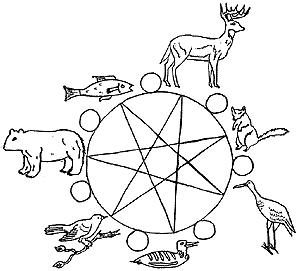
These clans have a major connection to the Chippewa's complicated religion. It is believed that seven great miigis, or holy beings, appeared to there ancestors to teach them a good way of life. One the miigis was unkind to the people and returned to the ocean. The other six remained and created the first doodem's. There was five, the Wawaazisii (bullhead), Baswenaazhi ( crane), Aan'aawenh (pintail duck), Nooke (bear), and Moozoonsii (little moose). Each of these tribes was symbolised with an animal.
Due to this  method of different clans, one can only marry if there are from different clans and
 the wife and husband pair will live in the clan of the husband.
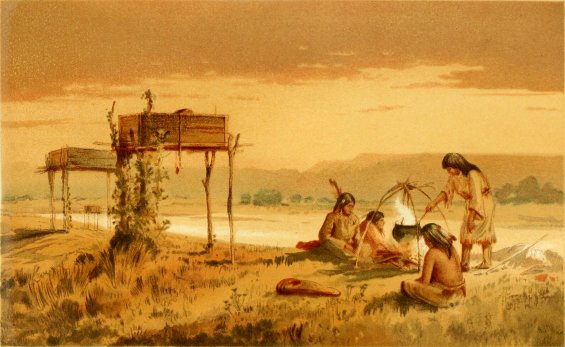
The Chippewa speak the Ojibway language and in modern day many speak English. They are a people know for the Birch bark canoes, sacred Birch bark scrolls, cultivation of wild rice, use of copper arrow points, beautiful bead work and using cowrie shells for trading. They lived a wooden lodges called a wiigwaam, and they are also known for their strange burial mounds. The Chippewa do to bury their dead but instead create a jiibegamig or "spirit-house" over a mound. This is a wooden stake in a mound engraved with the decease's clan sign. Although interesting, this caused many grave looting when the white man started to arrive in that area of the U.S.
The Chipppewa was involved in many American Treaties in its earlier days like most Native Americans and they have done a pretty good job at keeping there land and being humble in it all. One of the hero's from history though was Kechewaishke, or "Great Buffalo".  A man of extremely high stature for his was labeled as the chief of Lake Superior Chippewas, a group of 41 Ojibwa leaders in 1825.  No treaties went through without Kechewaishke approval. He is known for is work, dedication and signing of The Pine Tree Treaty in 1837 to change the laws of foresting in the Ojibwa territory, The Copper Treaty of 1842 over the production of copper across the land and the Ojibwa need for that copper,
and the 1845 Treaty of which led to the guarantee to hunt, fish and gather on all the ceded territory for the Ojibwa. Kechewaishke died on Sep. 7 1855, but helped much in creating territory and land for his people.


Sources:

wikipedia.org
www.indians.org
www.bigorrin.org
http://www.infoplease.com/

Monday, January 13, 2014

Dance With Wolves

The famous movie Dances With Wolves has always been part of my childhood. Although I never sat down and watched in the movie in one sitting as younger child, and  rarely understood what was happening in the film, it is a found memory of my weekends and of the person my mother is, for she loves the film. Now watching again as a young adult and in a different setting then I am used too, I have begun to see the true beauty of not only the cinematography, but the story as well of this film.
In the film I have begun to notice how the camera shots and such cinematography elements, such as music, tiny details in set and costume, and areal shots, have really made this story come to life. I like how our teacher told us when watching this film to think for certain elements that help the story along. Since I have been told to look for these elements, I have gained a lot  respect for the  movie now more then ever because of a the small beauty's that shine through  and then to truly make the movie rememberable. Even though the cinematography in great in the film I feel that there are parts where the story it self lacks and I wish the film stretched m
ore into the life of the Sioux people. I understand how the film tried to show the communication between the white man and the Native Americans of past, and to show that communication and understanding can be gained if given the effort, but on a very personal level I wish that in the movie they showed more of John Dunbar learning of the Sioux's culture. All in all though, I have really come to love this film's beauty and its message.